Glück Auf!
Namentlich ist mir die Mine kein Begriff. Die DDR war bei etlichen Bergbauprojekten in der Mongolei beteiligt. Ich habe mal etwas im Internet rumgekratzt und einiges beim USGS gefunden. Daraus lässt sich grob die Bergbauaktivität auf der Lagerstätte ableiten. Die Lagerstätte wird ausschließlich im Zusammenhang mit Wolframproduktion erwähnt. Wolfram und Molybdän sind aber genetisch eng aneinander gebunden bei Lagerstätten, die man im pneumatolytischen Pegmatoid- bis Greisenmileau ansiedelt. Letztlich entscheidet das Vorhandensein in der Metall liefernden Quelle, ob nur eines oder beide Metalle wirtschaftlich sind. Molybdän und Wolfram sind nur teilweise im gleichen Parameterbereich mobilisierbar und damit teilweise nach unterschiedlichen Lagerstättenbildungsprozessen anzutreffen. Beryll ist bei pegmatischen Bildungsbedingungen regelmäßig anzutreffen. Beryllium - wesentlicher Bestandteil von Beryll - gehört zu den silicophilen Elementen und ist damit bevorzugt in sauren/siliziumreichen Gesteinen (granitoide Gesteine) anzutreffen. Beryll wird bei Greisenbildung meist vollständig wieder aufgelöst. Das unter diesen Bedingungen gut lösliche Beryllium wird überwiegend abtransportiert und andernorts, z.B. Apophysen und Gänge oberhalb des Greisenkörpers zur Bildung neuer Berylliummineralien verwendet. Je nach Bedingungen kann dabei auch wieder Beryll entstehen, andere Berylliumminerale wie Bertrandit sind dann aber häufig anzutreffen. Derartige, sekundäre Berylle sind meist deutlich nadeliger und auch in Rosetten oder Igeln ausgebildet. Am Ende der Greisenbildung können sich auch innerhalb des Greisenkörpers wieder Beryllminerale bilden. Es gibt einen durchaus signifikanten Überschneidungsbereich der Bildungsbedingungen für Beryll und Molybdänit. Diese hier genannten Auzüge einer Kurzfassung sind nicht ansatzweise umfassend. Die Auswahl an Aussagen orientiert sich an der für Burentsogt recherchierten Gesteine. Wer hierzu Anmerkungen hat, kann diese gerne anführen. Mir fallen einige weitere Fundstellen ein, an denen Molybdänit und Beryll zusammen vorkommen: Wildenau (Vogtland), Altenberg (Erzgebirge), Zinnwald, Henneberg bei Weitisberga, Ehrenfriedersdorf, Horní Slavkov, Malyschewa und viele ähnliche Lagerstätten im Ural. Für die erstgenannten Fundstellen sind zwar Molybdänit und Beryll bekannt, Stufen aber selten, auf denen beide Minerale zu beobachten sind. Ein Beispiel für Ehrefriedersdorf ist das hier:
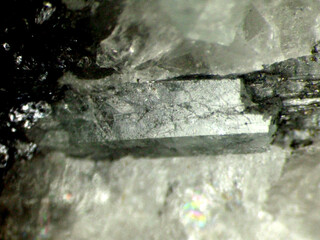
Beryll, Molybdänit und Amazonit aus der Mongolei
Die Region Erzgebirge/Vogtland weist zudem weitere Regionen auf, in denen Beryll und Molybdänit in Nachbarschaft vorkommen, wenn auch nicht für ein und die selbe Fundstelle gelistet. Bei Malyschewa und anderen Fundstellen im Ural sind mir Mineralgemeinschaften aus Beryll und Molybdänit auf der selben Stufe bekannt. Für die Ost Kounrad Mo-W Lagerstätte finden sich Bilder mit Beryll und Molybdänit auf der selben Stufe. Ich stimme aber in jedem Fall smaragd123 zu, dass Beryll + Molybdänit eine interessante Mineralgemeinschaft ist.
google maps Koordinaten für die Burentsogt Mine: 46.73674143628328, 111.703112932812
Erwähnungen in den USGS Jahrbüchern:
1963: In 1963, the country´s production of wolfram concentrates, from the Ih Hairhan and Burentsogt mines, probably totaled about 50 to 100 tons.
1964: More than 100 tons of wolfram-scheelite concentrates was produced at the Ih Hairhan and Burentsogt mines during 1964; operation costs were high at theses small tungsten mines and output targets were not fulfilled.
1965: keine Erwähnung
1966: keine Aufzeichnungen für den Jahrgang
1967: Comprehensive geological work continued, with assistance from most of the member nationsof the Council for Mutual Economics Aid. Bulgaria, Czechoslovakia, East Germany, Hungary, Poland, and the U.S.S.R. all allegedly participated in surveying and mapping activities. East Germany experts reportedly concentrated on exploration for rock crystal and gold and other precious metals. ... Reported references to labor inefficiency at the Ih Hairhan and Burentsogt mines implied the output, which fell short of production plans in 1966, also lagged in 1967. These wolram-scheelite mines accounted for all of Mongolia´s tungsten concentrate production.
1968: Production of the fluorspar and tungsten, Mongolia´s only mineral export items of consequence, currently shipped entirely to the U.S.S.R., apparently followed different courses in 1968. ... Output of tungsten, however, only amounted to about half that expected at the main Burentsogt and Ih Hairhan mines. The increasingly difficult mining conditions being encountered at both mines was apparently responsible for alling ore grades and plans to extend the depth of mining operations.
1969: All of the fluorspar and tungsten concentrate, Mongolia´s only mineral export items of consequence, are shipped to the U.S.S.R. Tungsten output, however, from the main Burentsogt and Ih Hairhan mines, reportedly was only 60 percent of the planned target.
1970: All of the fluorspar and tungsten concentrate, Mongolia´s only mineral export items of consequence, are shipped to the U.S.S.R.
1971: All of the fluorspar and tungsten concentrate, Mongolia´s only mineral export items of consequence, are shipped to the U.S.S.R.
1972: All of the fluorspar and tungsten concentrate, Mongolia´s only mineral export items of consequence, are shipped to the U.S.S.R.
1973: All of the fluorspar and tungsten concentrate, Mongolia´s only mineral export items of consequence, are shipped to the U.S.S.R. ... The capacity of the Burentsogt mine was double during the year as a result of expansion and reconstruction work carried out with aid from East Germany.
1974: Mongolian mineral commodity exports to the U.S.S.R. included a small quantity (53 tons) of tungsten concentrate and raw material not specified, ferrous metal scrap, cement, and a significant tonnage of metallurgical grade fluorspar.
1975: keine Erwähnung
1976: Output of tungsten from The Burentsogt mine and from a scheelite deposite on Jayrhan Maountain ranges between 100 and 200 tons of concentrates annually.
1977: keine Erwähnung
1978/1979 keine Erwähnung
1980: keine Erwähnung
1981: keine Erwähnung
1982: keine Erwähnung
1983: keine Erwähnung
1984: keine Erwähnung
1985: Production of tungsten from the Buren Tsogt (also known as Booren Chogt) Mine, reportedly had increased aubstantially since 1982. Most tungsten ore and ocncentrates was exported to East European countries
1986: during the current 5-year plan, Mongolia planned to export copper, fluorspar concentrates, molybdenum, tin, and tungsten to Czechoslovakia, the German Democratic Republic, Hungary, Poland, Romani, and the U.S.S.R.
1987: keine Erwähnung
1988: Since 1974, tungsten had been produced mainly from Burentsogt Mine in Suhbaatar. (Tonnen W Produktion gesamt Mongolei, geschätzt: 1984: 1500; 1985: 1500; 1986: 1500; 1987: 1500; 1988: 2000)
1989: Tungsten mining operations were at Burentsogt, and Yugoayr.
1990: Other tungsten mining operations, with the Soviet and member countries of CMEA, were at Burentsogt, Ikh-Khairkhan, Kobdo Gol, Kyzyl Tay, Tumentsogt, and Yugozy.
1991: Tungsten production was mainly by a joint venture of Mongolia and the former East Germany at Burentsogt in Suhbaatar Aymag and by a state-owned enterprise at Ulaan Uul in Bayan Olgiy Aymag and at Ongon Khalrkhan in Tov Aymag. A small quantitiy of tungsten was also produced at the Modot Mine as a byproduct. Tungsten ore reserves at Burentsogt reportedly will be depleted in 1 to 2 years.
1992: "Most joint-venture operations with East European countries for the production of tin and tungsten bad been closed since 1990.
1993: keine Erwähnung
1994: According to the Mongolian Embassy in Washington, DC, the State-owned Mongol Erdene Mining had reopened the Burentsogt Mine in Dornod Aymag in southeastern Mongolia.
1995: Tungsten mining was at the Burentsogt Mine in Dornod Aymag in southeastern Mongolia. (Tonnen W Produktion gesamt Mongolei: 1991: 300; 1992: 260; 1993: 250; 1994: 150; 1995: 200)
1996: Tungsten was mined at the Burentsogt Mine in Dornod Aymag in southeastern Mongolia.
1997: The Burentsogt Mine in Dornod Aymag in southeastern Mongolia, the Ulaan Uul and the Khovd Gol Mines in Bayan Olgiy in western Mongolia, and the Tsagaan Davaa Mine in Tov Ayamg in north-central Mongolia remained closed in 1997.
1998-2016: keine Erwähnung
https://en.wikipedia.org/wiki/B%C3%BCrentsogt_Tungsten_Mine: closed around 2009
Buch:
https://www.geokniga.org/bookfiles/geokniga-mineralogo-geohimicheskie-osobennosti-redkometalnyh-granitoidov-mongolii.pdfDie im Zusammenhang mit Burentsogt genannten Gesteine sind: Granosyenit, Mikroklin-Albit-Granit, Amazonit-Granit, Amazonit-Pegmatoid, Greisen, vergreister Granit, Biotit-Alaskit, Mikroklin-Albit-Alaskit, Mazonit-Albit-Alaskit, Biotit-Granit
Es sind zahlreiche geochemische Analysen zu Gesteinen und Mineralen enthalten. Die Analysen zielen vor allem auf genetische Zusammenhänge ab, weniger auf Metallgehalte der Lagerstätte.
Mit freundlichen Grüßen
Das Felsenmammut


 Thema: Beryll, Molybdänit und Amazonit aus der Mongolei (Gelesen 2182 mal)
 Mineralienatlas - Fossilienatlas - Info-Center
 Neueste Beiträge