

 Homepage
  Calendar
  Collector's characteristics
  History of Mineralienatlas
  Howto sponsor
  Our sponsores
  Search term inside Encyclopedia
  Full-text search
  Mineral by property
  Mineral by chemistry
  Help and how it works
  Mining
  Localities
  Geology (Rocks)
  Mineralogy (Minerals)
  Palaeontoloy (Fossils)
  Literature and Books
  Equipment and tools
  Portraits
  Encyclopedia pathes
  Media gallery
  Image reel
  User image galleries
  Images of the day
  Best of Images
  Newest forum contributions





1.357 Gäste, 1 Mitglied (1 Versteckte)
Derzeit sind keine Benutzer im Chat

06. Apr. - Tatort Franken – Das steinerne Grab der Riesenlurche
10. Apr. - Mineralienbörse im Lausitz-Center in Hoyerswerda
11. Apr. - Mineralienbörse im Lausitz-Center in Hoyerswerda
11. Apr. - 23. Mineralien-INFO im Ahrntal - Südtirol
11. Apr. - Mineralien.- und Fossilienbörse Rosenheim - Auer Festhalle
12. Apr. - 31. Mineralien- und Fossiliensammlerbörse Eggenburg / AT
12. Apr. - Mineralienbörse Herborn-Merkenbach
17. Apr. - GERA: Bildvortrag „Der Einfluss Preußens auf den Bergbau im
19. Apr. - 25. Bayerwald-Mineralienbörse Bad Kötzting, DE
26. Apr. - 34. Mineralien- und Fossilienbörse Arnsberg-Müschede, DE
09. May - 77. Internationale Mineralienbörse in Freiberg/Sachsen
09. May - 50. Mineralien- & Fossilienbörse “MINERANT2026” - Golden
09. May - 43. Aschaffenburger Mineralienbörse
10. Apr. - Mineralienbörse im Lausitz-Center in Hoyerswerda
11. Apr. - Mineralienbörse im Lausitz-Center in Hoyerswerda
11. Apr. - 23. Mineralien-INFO im Ahrntal - Südtirol
11. Apr. - Mineralien.- und Fossilienbörse Rosenheim - Auer Festhalle
12. Apr. - 31. Mineralien- und Fossiliensammlerbörse Eggenburg / AT
12. Apr. - Mineralienbörse Herborn-Merkenbach
17. Apr. - GERA: Bildvortrag „Der Einfluss Preußens auf den Bergbau im
19. Apr. - 25. Bayerwald-Mineralienbörse Bad Kötzting, DE
26. Apr. - 34. Mineralien- und Fossilienbörse Arnsberg-Müschede, DE
09. May - 77. Internationale Mineralienbörse in Freiberg/Sachsen
09. May - 50. Mineralien- & Fossilienbörse “MINERANT2026” - Golden
09. May - 43. Aschaffenburger Mineralienbörse
06. Apr. - Tatort Franken – Das steinerne Grab der Riesenlurche
10. Apr. - Mineralienbörse im Lausitz-Center in Hoyerswerda
11. Apr. - Mineralienbörse im Lausitz-Center in Hoyerswerda
11. Apr. - 23. Mineralien-INFO im Ahrntal - Südtirol
11. Apr. - Mineralien.- und Fossilienbörse Rosenheim - Auer Festhalle
12. Apr. - 31. Mineralien- und Fossiliensammlerbörse Eggenburg / AT
12. Apr. - Mineralienbörse Herborn-Merkenbach
17. Apr. - GERA: Bildvortrag „Der Einfluss Preußens auf den Bergbau im
19. Apr. - 25. Bayerwald-Mineralienbörse Bad Kötzting, DE
26. Apr. - 34. Mineralien- und Fossilienbörse Arnsberg-Müschede, DE
09. May - 77. Internationale Mineralienbörse in Freiberg/Sachsen
09. May - 50. Mineralien- & Fossilienbörse “MINERANT2026” - Golden
09. May - 43. Aschaffenburger Mineralienbörse
10. Apr. - Mineralienbörse im Lausitz-Center in Hoyerswerda
11. Apr. - Mineralienbörse im Lausitz-Center in Hoyerswerda
11. Apr. - 23. Mineralien-INFO im Ahrntal - Südtirol
11. Apr. - Mineralien.- und Fossilienbörse Rosenheim - Auer Festhalle
12. Apr. - 31. Mineralien- und Fossiliensammlerbörse Eggenburg / AT
12. Apr. - Mineralienbörse Herborn-Merkenbach
17. Apr. - GERA: Bildvortrag „Der Einfluss Preußens auf den Bergbau im
19. Apr. - 25. Bayerwald-Mineralienbörse Bad Kötzting, DE
26. Apr. - 34. Mineralien- und Fossilienbörse Arnsberg-Müschede, DE
09. May - 77. Internationale Mineralienbörse in Freiberg/Sachsen
09. May - 50. Mineralien- & Fossilienbörse “MINERANT2026” - Golden
09. May - 43. Aschaffenburger Mineralienbörse
 Imprint
 Data protection clause
 Our team

To complete our information constantly, we need your support. With us, everyone can and should participate. Currently Mineralienatlas is used and expanded by 10533 members. Every month hundreds of thousands of visitors use our website as an information source.

| Dieser Artikel befasst sich mit den Eisenerzlagerstätten im Raum Adorf, die geologisch auch in Teile des Ostsauerlandes übergreifen. Hier wird ein Stück deutscher Bergbaugeschichte zusammengefasst, deren Bedeutung immer im Schatten der großen deutschen Lagerstätten stand. So bin ich bemüht die histo ... moreDieser Artikel befasst sich mit den Eisenerzlagerstätten im Raum Adorf, die geologisch auch in Teile des Ostsauerlandes übergreifen. Hier wird ein Stück deutscher Bergbaugeschichte zusammengefasst, deren Bedeutung immer im Schatten der großen deutschen Lagerstätten stand. So bin ich bemüht die historischen Zusammenhänge etwas näher zu beleuchten. Viele der hier aufgeführten Informationen zu Orten und Bergwerken sind bereits aus dem Bewusstsein der einheimischen Bevölkerung verschwunden. |
| For Mineral collectors who travel in their vacation to the mining area of La Union, the mina Precaución is an easy to reach and in 2010 a worthwhile target to collect attractive pieces with hemimorphite, calcite and more minerals on contrast rich matrix. Equipped with helmet, forehead lamp, chisel ... moreFor Mineral collectors who travel in their vacation to the mining area of La Union, the mina Precaución is an easy to reach and in 2010 a worthwhile target to collect attractive pieces with hemimorphite, calcite and more minerals on contrast rich matrix. Equipped with helmet, forehead lamp, chisel and hammer nice pieces can be rescued easily, taking into account the security rules for mining visits. |
| Als Bestimmungsmerkmal fallen zweifarbige Einsprenglinge (blaugrau und rosarot) auf, die allerdings auch in der Variante RP26 vorkommen. Das wichtigste Kriterium, um diese beiden Varianten auseinander halten zu können, sind die in der intrusiven Variante vorhandenen, schmalen Zonierungen, welche die ... moreAls Bestimmungsmerkmal fallen zweifarbige Einsprenglinge (blaugrau und rosarot) auf, die allerdings auch in der Variante RP26 vorkommen. Das wichtigste Kriterium, um diese beiden Varianten auseinander halten zu können, sind die in der intrusiven Variante vorhandenen, schmalen Zonierungen, welche die blaugrauen Kristalle dünn umschließen. Generell finden sich 2 Arten von Einsprenglingen in der intrusiven Variante: 1. kleine, zerbrochen wirkende rosarote und 2. größere, blaugraue mit schmaler Zonierung, welche die gleiche Farbe aufweist, wie die der Kleineren Einsprenglinge. ... Ein Beitrag von Jörg-Florian J. |
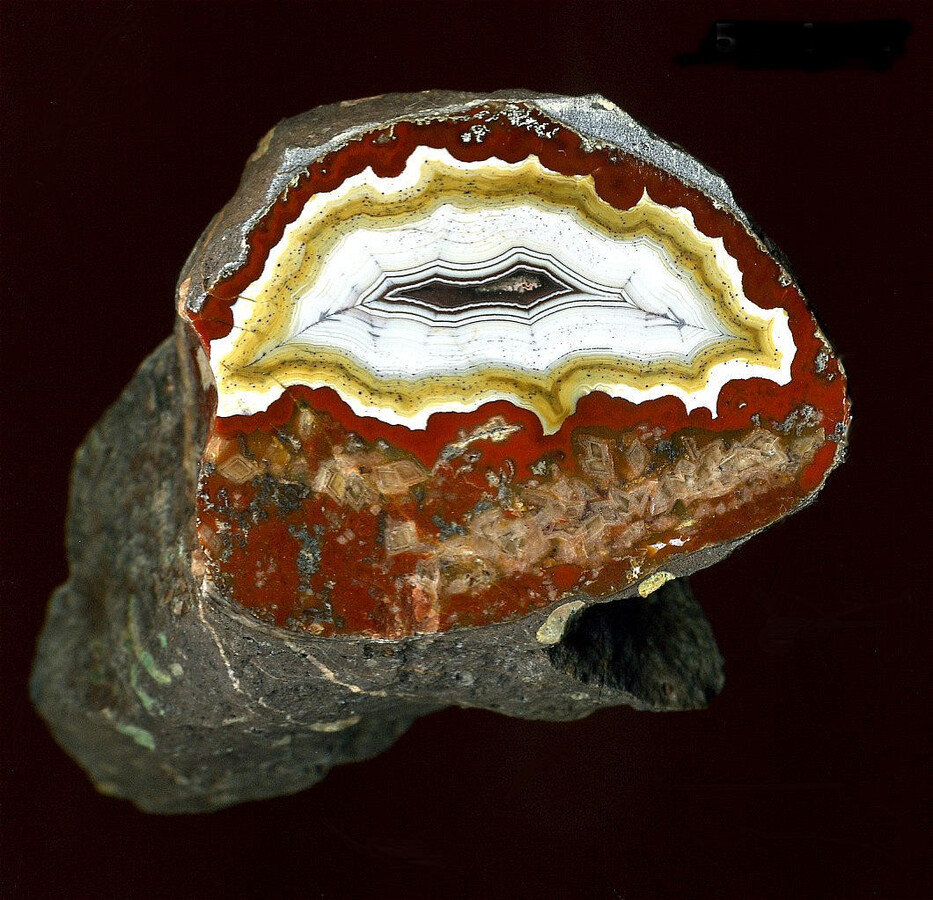
| Nature forms over time, e.g. believed due to weathering, mineralization or crystallization, landscapes and rocks in which the human imagination identifies often strange formations out of the real world. An example of this are agates that, generally outwardly unattractive pose, in their interiors of ... moreNature forms over time, e.g. believed due to weathering, mineralization or crystallization, landscapes and rocks in which the human imagination identifies often strange formations out of the real world. An example of this are agates that, generally outwardly unattractive pose, in their interiors often true works of art. |
| ... Wenn die Körner plattenförmige (laminae) Gestalt haben, so bezeichnet man diese Aggregate, je nach Größe, als schuppig oder blättrig (lamellar). Die individuellen Platten sind im Allgemeinen parallel, können aber auch um ein gemeinsames Zentrum gebogen sein und konzentrische Formen bilden. Wenn ... more... Wenn die Körner plattenförmige (laminae) Gestalt haben, so bezeichnet man diese Aggregate, je nach Größe, als schuppig oder blättrig (lamellar). Die individuellen Platten sind im Allgemeinen parallel, können aber auch um ein gemeinsames Zentrum gebogen sein und konzentrische Formen bilden. Wenn die Platten dünn und trennbar sind, bezeichnet man die Aggregate als blättrig oder schieferig. Wenn ein Mineral aus kleinen Schuppen besteht, wird es als glimmerartig bezeichnet. Beispiele: Calcit und Gips (rosettenartig), Glimmer (charakteristisch glimmerartig),Talk und manche Hämatitaggregate (schuppig) ... ein Beitrag von Perter Seroka |